

Edge of Breakup
Video Categories
Fix Your Humbucker Lead Tone! | Cunningham Zonk MKI Fuzz | Feat. Giordano Guitars & Sunbear Pickups
The Cunningham Amps Zonk MKI in a stunning blackout finish — paired with the Giordano Guitars Veloce and a genuine 1966 Fender Princeton Reverb. Welcome back to Edge of Breakup.
The Cunningham Amps Zonk MKI Fuzz (Blackout Finish) pairs with the Giordano Guitars Veloce — Sunbear Pickups SB-62PAT# Archive Humbuckers — into the 1966 Fender Princeton Reverb (black panel). The Effectrode Tube Vibe joins for modulation.
The Zonk MKI is Tim Cunningham's hand-built take on the Hornby Skewes Zonk Machine — a close cousin of the Tone Bender MKI, but with a distinct input capacitor value that rolls off low end before the fuzz stage, producing a more angular, midrange-forward, and characteristically gnarly character compared to the fuller MKI. This particular unit's blackout finish is a genuinely striking departure from Cunningham's usual builds — same hand-wired NOS germanium construction underneath, just dressed differently.
The Sunbear SB-62PAT# Archive Humbuckers in the Giordano Veloce reference the brief transitional era when Gibson swapped from the "Patent Applied For" decal to the Patent Number decal — construction unchanged, short-length Alnico V magnets. Bridge 7.7K / Neck 6.8K. Bright, spanky, and vocal like the best vintage SG pickups, with a chime in the neck position that makes chords ring like a bell.
The 1966 Fender Princeton Reverb's black panel AB763 circuit is one of the cleanest, most neutral platforms in the vintage Fender catalog — no inherent grit baked in, just headroom, chime, and that signature mid-scoop, giving the Zonk MKI's gnarly midrange plenty of room to develop without fighting the amp for space. The Effectrode Tube Vibe rounds things out with rich, three-dimensional Uni-Vibe modulation.
🎛️ Cunningham Amps: https://www.cunninghamamps.co.nz
🎸 Giordano Guitars: https://www.instagram.com/_giordanoguitars_/
🎸 Sunbear Pickups: https://www.sunbearpickups.com
Subscribe for more boutique tone explorations.
🎸 Giordano Guitars Veloce | All-Mahogany | Sunbear SB-62PAT# Archive Humbuckers (AV Bridge 7.7K / AV Neck 6.8K)
🎛️ Cunningham Amps Zonk MKI Fuzz (Blackout Finish) | Effectrode Tube Vibe
🔊 1966 Fender Princeton Reverb (Black Panel AB763)
You've Got a Need for Tweed! | Origin Effects Deluxe 55
You've Got a Need for Tweed! The Origin Effects Deluxe 55 gets its own dedicated spotlight — an all-analog tribute to the 1955 Fender 5E3 Tweed Deluxe, paired with the Giordano Guitars Veloce and a genuine 1966 Fender Princeton Reverb. Welcome back to Edge of Breakup.
The Origin Effects Deluxe 55 takes center stage, paired with the Giordano Guitars Veloce — Sunbear SB-62PAT# Humbuckers, Emerson Custom Treble Bleeds — into the 1966 Fender Princeton Reverb (black panel).
The Deluxe 55 is Origin Effects' all-analog tribute to the legendary Fender 5E3 Tweed Deluxe from 1955 — a complete valve amp signal path recreated in miniature using carefully crafted transistor-based circuitry. Starting with a real Tweed Deluxe, Origin Effects ran an extensive process of testing and measurement to understand every detail of the original circuit, then redesigned their all-analog Amp Recreation circuitry to mimic its exact behavior. The push-pull output stage overdrives exactly the way the real amp's 6V6 power amp does, with a reactive load simulating the interaction between the power amp and speaker — a crucial part of valve amp "feel" that most pedals never attempt. The cathodyne phase inverter and the Tweed Deluxe's famously unconventional preamp design are recreated with equal accuracy, right down to the Tone control adding gain as it's turned up, exactly as it does on the original amp.
The Preamp switch mimics the effect of swapping a 12AY7 preamp valve for a 12AX7 — a popular mod among real Tweed Deluxe owners, now available at the flip of a switch. This takes the tone from a bright, articulate crunch to a warmer, higher-gain voice, unleashing a collapsing wall of fuzz with everything cranked. The Post EQ circuit comes after the Amp Recreation stage and ensures compatibility with traditional amps, modelers, power amps, and cabinet simulators — meaning the Deluxe 55 works in essentially any rig, not just a traditional guitar-amp signal chain.
Full specs: 1 MΩ input impedance, 1 kΩ output impedance, 100 mA current draw. High-quality buffered bypass. 9V DC 2.1mm center-negative power only (no battery option, by design, for lower noise and higher current headroom). Brushed stainless steel and aluminum enclosure. Designed and built in England. Available in Original and Black Edition finishes.
Paired here with the 1966 Fender Princeton Reverb — a black panel AB763 circuit that's about as clean and neutral a platform as exists in vintage Fender territory, giving the Deluxe 55 a genuinely blank canvas to do its transforming work on. The Sunbear SB-62PAT# Humbuckers in the Giordano Veloce — short-length Alnico V magnets referencing the brief Gibson transitional era between the PAF and Patent Number decal — bring a bright, spanky character reminiscent of the best vintage SG pickups, with the Emerson Custom Treble Bleeds keeping that clarity fully intact through every volume knob sweep across the Deluxe 55's full range.
🎛️ Origin Effects Deluxe 55: https://origineffects.com/product/deluxe55/
🎸 Giordano Guitars: https://www.instagram.com/_giordanoguitars_/
🎸 Sunbear Pickups: https://www.sunbearpickups.com
Subscribe for more boutique tone explorations.
🎸 Giordano Guitars Veloce | All-Mahogany | Sunbear SB-62PAT# (AV Bridge 7.7K / AV Neck 6.8K) | Emerson Custom Treble Bleeds
🎛️ Origin Effects Deluxe 55 | 12AY7/12AX7 Preamp Switch | Push-Pull Power Amp Simulation | Reactive Load | 1MΩ Input Impedance
🔊 1966 Fender Princeton Reverb (Black Panel AB763)
'66 Fender Princeton Reverb | Vintage Amp Showcase | Feat. Giordano Guitars Veloce & Sunbear Pickups
The 1966 Fender Princeton Reverb — genuine vintage black panel from 60 years ago, and a whole lot of tone and pedal territory to explore. Welcome back to Edge of Breakup.
https://youtu.be/E3jqoIX082s?is=kTCbkE9N5McqChUi
The 1966 Fender Princeton Reverb takes the spotlight, paired with the Giordano Guitars Veloce — Sunbear SB-62PAT# Humbuckers, Emerson Custom Treble Bleeds. The Cunningham Amps Zonk MKI Fuzz, Origin Effects Deluxe 55, and Effectrode Tube Vibe all make appearances.
The Princeton Reverb's black panel AB763 circuit is one of the cleanest, most neutral platforms in the entire vintage Fender catalog — no inherent grit or coloration baked into the amp itself, just headroom, chime, and that famous mid-scoop. That neutrality makes it a genuinely great canvas for testing what different pedals actually do to a signal, rather than a starting point that's already coloring the tone before anything gets stomped on.
The Sunbear SB-62PAT# Humbuckers in the Giordano Veloce — short-length Alnico V magnets referencing the brief Gibson transitional era between the PAF and Patent Number decal — bring a bright, spanky character reminiscent of the best vintage SG pickups. The Emerson Custom Treble Bleeds keep that clarity fully intact through every volume knob sweep, across clean tones and everything that gets layered on top.
The Cunningham Amps Zonk MKI Fuzz — Tim Cunningham's hand-built take on the Hornby Skewes Zonk Machine, a close cousin of the Tone Bender MKI with its own angular, midrange-forward character — is the first stop into genuine vintage fuzz territory, giving the neutral Princeton a raw, gnarly edge.
The Origin Effects Deluxe 55 shows up as a guest — an all-analog recreation of the 1955 Fender 5E3 Tweed Deluxe, deliberately paired with the black panel Princeton rather than a real tweed amp, to see whether the pedal can genuinely pull that tweed character out of a neutral platform rather than just confirming it on an amp that already sounds tweed-ish. Push-pull power amp simulation with reactive load, cathodyne phase inverter recreation, a Preamp switch toggling between 12AY7 and 12AX7 valve character, and a Tone control that adds gain as it's turned up — all built to mimic exactly how the real 5E3 behaves, not just how it sounds.
The Effectrode Tube Vibe closes things out with rich, three-dimensional modulation on top of whatever gain stage came before it.
🎸 Giordano Guitars: https://www.instagram.com/_giordanoguitars_/
🎸 Sunbear Pickups: https://www.sunbearpickups.com
🎛️ Cunningham Amps: https://www.cunninghamamps.co.nz
🎛️ Origin Effects Deluxe 55: https://originaleffects.com
Subscribe for more boutique tone explorations.
🔊 1966 Fender Princeton Reverb (Black Panel AB763)
🎸 Giordano Guitars Veloce | All-Mahogany | Sunbear SB-62PAT# (AV Bridge 7.7K / AV Neck 6.8K) | Emerson Custom Treble Bleeds
🎛️ Cunningham Amps Zonk MKI Fuzz | Origin Effects Deluxe 55 (Guest) | Effectrode Tube Vibe
The Perfect Fuzz Face! | Time-O-Lite Fuzz | R2R Electric | ES-335 Tones | 66 Princeton Reverb
The Perfect Fuzz Face! | Time-O-Lite Fuzz | R2R Electric | ES-335 Tones | 66 Princeton Reverb
Semi-hollow body. NOS OC44 black glass germanium. A swirling all-tube univibe. This time through a 12-watt Princeton Reverb. Welcome back to Edge of Breakup.
Watch all my R2R Electric videos in this playlist:
https://www.youtube.com/playlist?list=PLLY1KzQHoiH19TwvpSLBOzOmEblLQZ0pP
In this episode, the R2R Electric x Waterslide Guitars Time-O-Lite Fuzz takes center stage — piloted by my 1967 Gibson ES-335 loaded with Ron Ellis 60's Bette Humbuckers and Emerson Custom Treble Bleeds, into a vintage 1966 Fender Princeton Reverb. Guest starring the Effectrode Tube Vibe.
The Time-O-Lite is a long-time collaboration between R2R Electric founder Chris Vincent and Waterslide Guitars — over two years in development. The enclosures are genuine Time-O-Lite industrial darkroom timers, converted by hand into fuzz pedals with painstaking care for the original hardware. The concentric potentiometer configuration repurposes original controls: the lower larger pointer for Volume, the upper small red pointer for Fuzz — period-correct CTS units, a 1966 CTS 500k and a 1983 CTS 1k. NOS Allen-Bradley carbon comp resistors, NOS capacitors, a 1979 ITT .01uf chicklet-style cap, and true bypass throughout. Every pedal ages uniquely — each tells its own story before you've played it.
This unit features hand-selected NOS OC44 black glass germanium transistors — a low-noise, high-gain device with warm, musical compression that sits beautifully in a Fuzz Face-style two-transistor circuit. R2R also builds the Time-O-Lite with OC42 and AC107 germanium transistors, each with its own distinct character. The range spans from gated and spitty at low bias to large, open, blooming fuzz at full bias. No buffers upstream — this must sit first in your signal chain.
The 1967 Gibson ES-335 is one of the great guitar-and-fuzz pairings in existence. The semi-hollow body's natural woody resonance and acoustic bloom add a dimension to a germanium fuzz that a solid body simply cannot replicate. The Ron Ellis 60's Bette Humbuckers are specifically voiced for this application — based on the patent-era humbuckers used in early-to-late 60s ES Gibson guitars, fundamentally honest pickups that let the acoustic character of the instrument speak clearly. Hand-wound in Carlsbad, California and named after Ron's mother, the Bettes have beautiful musical timbre on every note — you can genuinely hear the wood of the guitar through them. The Emerson Custom Treble Bleeds keep high-frequency detail intact as you roll back the guitar's volume control — in a fuzz-forward rig, that's not a luxury, it's essential.
What makes this session different from the earlier ES-335 Time-O-Lite episode is the amp. Where the Deluxe Reverb provided 22 watts of bold, authoritative American clean headroom, the 1966 Princeton Reverb's AA1164 circuit — 12 watts, single 6V6, tube rectifier — brings an intimacy and touch sensitivity that changes the conversation entirely. The semi-hollow body breathes more freely into this smaller platform, the OC44 germanium fuzz blooms differently against the Princeton's compressed voice, and the overall dynamic feel shifts from bold and punchy to warm and elastic. Same fuzz. Same guitar. Completely different story.
The Effectrode Tube Vibe adds its all-tube photocell-and-bulb univibe voice — triode tubes running at real amp plate voltages, with Classic swampy throb, Smooth ethereal chorus, and Chorus/Vibrato switching for Hendrix-style vibe or pure pitch-shifting vibrato.
Be sure to join @r2relectric's email list so you know when his ultra limited hand-built NOS fuzzes, boosts and wahs hit Reverb to purchase! They DO NOT hang around long!
https://www.r2relectric.com/how-to-order
Subscribe for more boutique tone explorations.
🎸 1967 Gibson ES-335 | Ron Ellis 60's Bette Humbuckers | Emerson Custom Treble Bleeds
🎛️ R2R Electric x Waterslide Guitars Time-O-Lite Fuzz | NOS OC44 Black Glass Germanium Transistors
🎛️ Effectrode Tube Vibe
🔊 1966 Fender Princeton Reverb
Searchable, categorized index of all my Youtube Videos: https://www.edgeofbreakup.studio
Other R2R Electric videos you might like:
https://www.edgeofbreakup.studio/latest-videos/the-best-nos-fuzz-face-r2r-electric-geface-deluxe https://www.edgeofbreakup.studio/latest-videos/i-won-a-nos-mullard-tone-bender-fuzz-auction-r2r-electric-mk15-into-a-vintage-65-deluxe-reverb https://www.edgeofbreakup.studio/latest-videos/r2r-electric-uniform-fuzz https://www.edgeofbreakup.studio/latest-videos/electric-machine-fuzz-r2r-electric-zonk-machine https://www.edgeofbreakup.studio/latest-videos/gronlund-surprised-me-with-a-second-guitar-5-nos-germanium-fuzzes-into-a-vintage-65-deluxe https://www.edgeofbreakup.studio/latest-videos/the-best-vintage-style-fuzz-r2r-electric-replica-series-mk15-fuzz https://www.edgeofbreakup.studio/latest-videos/1959-fender-tweed-deluxe-5e3-vintage-amp-showcase https://www.edgeofbreakup.studio/latest-videos/r2r-electric-pkiii-fuzz https://www.edgeofbreakup.studio/latest-videos/i-won-this-nos-tone-bender-mkii-fuzz-auction-too-r2r-electric-into-a-vintage-65-deluxe-reverb https://www.edgeofbreakup.studio/latest-videos/milkman-sound-creamer-20w-with-jupiter-12-la-speaker-humbucker-tones https://www.edgeofbreakup.studio/latest-videos/the-most-misunderstood-fuzz-in-british-history-r2r-pkiii-tone-bender-into-a-vintage-65-deluxe https://www.edgeofbreakup.studio/latest-videos/the-best-vintage-style-fuzz-r2r-electric-replica-series-mkii-fuzz https://www.edgeofbreakup.studio/latest-videos/r2r-electric-waterslide-time-o-lite-fuzz-/-fuzz-face-shootout-/-geface-deluxe-ge-distorter-nkt https://www.edgeofbreakup.studio/latest-videos/kauer-guitars-korona-wolfetone-kauerbucker-humbuckers-guitar-demo https://www.edgeofbreakup.studio/latest-videos/wolfetone-pickups-meaner-p90-bridge-feat-grez-mendocino-jr-jules-leyhe-blues-guitarist https://www.edgeofbreakup.studio/latest-videos/the-best-zonk-machine-fuzz-electric-machine-pro-r2r-electric https://www.edgeofbreakup.studio/latest-videos/r2r-electric-mki-pro-fuzz https://www.edgeofbreakup.studio/latest-videos/nash-guitars-s63-feat-r2r-electric-time-o-lite-fuzz-66-fender-princeton-reverb https://www.edgeofbreakup.studio/latest-videos/black-volt-sparrow-amplifier-w/-r2r-electric-booster-channel-feat-1967-gibson-guitars-es-335 https://www.edgeofbreakup.studio/latest-videos/i-helped-design-this-guitar-losch-guitars-feat-built-in-r2r-electric-treble-booster https://www.edgeofbreakup.studio/latest-videos/the-unsung-hero-of-early-british-fuzz-r2r-electric-supa-mki-into-a-vintage-65-deluxe-reverb https://www.edgeofbreakup.studio/latest-videos/r2r-electric-pre-amp-vintage-wah
Decker Amp Co. Hummingbird 20
A brand new amp, that has only JUST gone live on the Decker website — could this replace your Deluxe Reverb? The Decker Amp Co. Hummingbird 20. Welcome back to Edge of Breakup.
Get yours here:
https://www.decker-ampco.com/products/hummingbird-20
The Decker Amp Co. Hummingbird 20 — featuring Colin Decker's lovely cleans and gain, 2 band EQ, exclusive 3-voice reverb circuit and all-tube power scaling — paired up with my 2002 Gibson Custom Shop Les Paul R8 Historic, Ron Ellis LRP Humbuckers, wired with my signature Emerson Custom x Edge of Breakup Les Paul Prewired Kit & Emerson Custom Treble Bleeds on both volumes. The R2R Electric Klone (Serial #004) and R2R Electric x Henri Cash Cash Boost both feature.
Handbuilt entirely in California, Decker amplifiers capture the warmth and soul of classic tube amps while offering the touch-sensitivity, reliability, and features modern players need. Drawn from Colin Decker's decades of playing, touring, and modifying amps for studio and stage, Decker amps are original designs reflecting his "just play" philosophy — cathode-biased circuits for harmonic richness, simple controls that keep you focused on playing, and responsive combos that feel alive in the room.
The Hummingbird 20 succeeds the Hummingbird 15 — and the improvements are substantial. All-tube power output attenuation across six profiles: 20W, 18W, 15W, 10W, 5W, and 1W — true output-tube attenuation. The Spaces reverb circuit adds three selectable size and depth voicings.
Full specs:
Cathode-biased, Class A design.
2x 6V6 2x ECC83, 1x ECC832 reverb tube. Controls: Volume, Low, High, Reverb Mix + 3-space selector.
Speaker outputs: single 8Ω, single 4Ω, or 8Ω internal + 8Ω extension.
Custom-design transformers by Soursound.
Precision-selected Allen Bradley carbon composition, Vishay metal film, Beyschlag, Piher, and Morel resistors.
Jupiter, Mallory, Vishay, and Mial capacitors.
Sprague and F&T electrolytics.
Carling switches and jacks throughout.
Point-to-point construction using military-spec ETFE wire on chassis-mounted tag strips.
Shock-mounted tube sockets, vibration dampening throughout.
Heavy-duty seam-welded aluminum chassis with stainless steel control faceplate.
Cabinet: special-design Decker Royal 50 Ceramic speaker.
Solid AA Eastern White Pine, finger-jointed, AA Baltic Birch baffle and rear panels, poplar and pine cleating, stainless steel hardware, signature Decker heavy-duty leather handle.
30 lbs unpackaged. 22"W x 18"H x 10"D.
Designed, manufactured, and assembled 100% by hand in the USA.
Pedals: The R2R Electric Klone, Serial #004, is Chris Vincent's exacting take on the Klon-style transparent overdrive, hand-wired with the same no-compromise NOS component philosophy behind every R2R build. The Cash Boost is Henri Cash's (Starcrawler) signature germanium boost — a collaboration between Henri and Chris Vincent, close friends in the LA music and gear scene — built as a faithful reproduction of a 1960s Dallas Rangemaster circuit.
The Hummingbird 20 aims squarely at the conversation the internet has been having about the Deluxe Reverb being "the best amp ever," and makes the case that THIS might be the real answer.
🔊 Decker Amp Co.: https://www.deckeramps.com
🎸 Ron Ellis Pickups: https://www.ronellispickups.com
🎛️ R2R Electric: https://www.r2relectric.com
Subscribe for more boutique tone explorations.
🎸 2002 Gibson Custom Shop Les Paul R8 Historic | Ron Ellis '50s LRP Set (Duane Allman '57 Goldtop Spec) | Emerson Custom EoB LP Kit + 2x Treble Bleed
🎛️ R2R Electric Klone (Serial #004) | R2R Electric x Henri Cash Cash Boost
🔊 Decker Amp Co. Hummingbird 20 | SPACES 3-Voice Reverb | 6-Stage Power Scaling (20W-1W) | Cathode-Biased Class A | 2x 6V6 | Decker Royal 50 Ceramic Speaker
If you could only have one fuzz 🤔 Expresso FX Fuzz Bender Mojo Edition (MKII & MK1.5) | Jules Leyhe
Two legendary Tone Bender circuits. Three NOS Mullard CV7005 transistors. One toggle switch. Welcome back to Edge of Breakup.
The Expresso FX Fuzz Bender Mojo Edition is played by Oakland blues guitarist Jules Leyhe, running into the Grez Guitars Mendocino Junior with a Wolftone Meaner Dog Ear P-90, into a 1957 Fender Tweed Princeton 5F2-A with a Weber CVA-8 pre-broken-in 8" alnico speaker. The Effectrode Tube Vibe joins from 06:21.
Expresso FX builder Sof has built his Fuzz Bender line around one of the most historically rich fuzz lineages in existence — the Sola Sound Tone Bender family. The Mojo Edition houses both the MKII and MKI.V circuits in one enclosure, selectable via toggle switch, with a side-mounted Bias knob for further tweaking. The MKII (explored from 00:42 and 08:41) is the three-transistor circuit that defined late-1960s British rock in the hands of Jimmy Page, Jeff Beck, and Eric Clapton — an extra gain stage slamming the circuit harder for more sustain, gain, and midrange density. The MKI.V (explored from 03:46) sits in transitional territory between the raw, maximally-saturated MKI and the more refined MKII — looser, more unpredictable, deeply expressive. Having both voiced with the same trio of transistors makes for an extraordinary A/B experience.
At the heart of the Mojo Edition: three hand-selected NOS Mullard CV7005 germanium transistors — two black glass, one metal can. Military-spec, same family as the celebrated NKT275, delivering a warm, articulate, touch-sensitive voice that responds to every nuance of pick attack and guitar volume. NOS WIMA TFF polyester film capacitors, NOS Philips and ROE electrolytic capacitors, NOS Allen-Bradley carbon comp resistors, premium Cliff UK jacks, 22 AWG solid core silver-plated copper wire with Teflon insulation. Fully hand-wired on genuine Vero stripboard. True bypass. Three-year warranty.
The Grez Guitars Mendocino Junior — reclaimed old growth Redwood body, one-piece Honduran mahogany neck, 24.75" scale, 5.75 lbs, wood harvested from 800-year-old timber — pairs with a Tone Bender-style fuzz in a way that rewards the exercise. The Wolftone Meaner Dog Ear P-90's midrange character feeds the MKII's front end with exactly the right signal, acoustically vibrant enough that the guitar's resonance opens up through the fuzz rather than compressing or flattening.
Jules Leyhe brings slide and fingerstyle blues to both circuits — including a genuinely impressive slide performance on low-action 9-gauge strings from 09:29.
🎛️ Expresso FX: https://expressofx.com
🎸 Grez Guitars: https://www.grezguitars.com
Subscribe for more boutique tone explorations.
🎸 Grez Guitars Mendocino Junior | Reclaimed Old Growth Redwood | Wolftone Meaner Dog Ear P-90
🎛️ Expresso FX Fuzz Bender Mojo Edition | NOS Mullard CV7005 Ge (2x Black Glass, 1x Metal Can) | MKII & MKI.V Selectable | Effectrode Tube Vibe
🔊 Vintage 1957 Fender Tweed Princeton 5F2-A | Weber CVA-8 Pre-Broken-In 8" Alnico Speaker
🎵 Guest Artist: Jules Leyhe
Recording Rig: Absolutely no virtual/IR/direct sounds. 4 mics on a real cab. Royer R-121, Lauten Audio LS-208, Ohma Ribbon on front of cab, Royer R10 on back of cab. All mics sent through Universal Audio Apollo x4 with default preamps and no digital preamp emulation plugins, mixed in Ableton Live 12.
Time-O-Lite Fuzz | R2R Electric | Telecaster Tones with a Vintage Fender Princeton Reverb!
A solid brass topped T-style. NOS OC44 black glass germanium. An all-tube univibe. And a vintage blackface Princeton Reverb. Welcome back to Edge of Breakup.
In this episode, the R2R Electric x Waterslide Guitars Time-O-Lite Fuzz takes center stage — piloted by my Gronlund Guitars T-Style with solid brass top, loaded with McNelly A5 Tele pickups and Emerson Custom treble bleed, into a vintage 1966 Fender Princeton Reverb. Guest starring the Effectrode Tube Vibe.
The Time-O-Lite is a long-time collaboration between R2R Electric founder Chris Vincent and Waterslide Guitars — over two years in development. The enclosures are genuine Time-O-Lite industrial darkroom timers, converted by hand into fuzz pedals with painstaking care for the original hardware. The concentric potentiometer configuration repurposes original controls: the lower larger pointer for Volume, the upper small red pointer for Fuzz — period-correct CTS units, a 1966 CTS 500k and a 1983 CTS 1k. NOS Allen-Bradley carbon comp resistors, NOS capacitors, a 1979 ITT .01uf chicklet-style cap, and true bypass throughout. Every pedal ages uniquely — each tells its own story before you've played it.
This unit features hand-selected NOS OC44 black glass germanium transistors — a low-noise, high-gain device with warm, musical compression sitting beautifully in a Fuzz Face-style two-transistor circuit. R2R also builds the Time-O-Lite with OC42 and AC107 germanium transistors, each with its own distinct character. The range spans from gated and spitty at low bias to large, open, blooming fuzz at full bias. No buffers upstream — this must sit first in your signal chain.
The Gronlund Guitars T-Style is the work of James Greene, building handcrafted guitars one at a time in Maine, USA. The brass top is the defining feature — a solid brushed brass sheet that fundamentally changes the resonant character of the instrument, adding density, sustain, and a harmonic complexity that a traditional wood-topped guitar simply doesn't produce. The McNelly A5 Tele pickups are Alnico 5, higher output than traditional vintage styles — tight bass, present mids, and a conveniently subdued treble that gives the player full control. Hand-made in Canada, they are exactly what McNelly's own builder says he would have made in 1950 if he were Leo Fender. The Emerson Custom treble bleed keeps top-end detail alive through the volume control — essential in any fuzz rig where cleanup off the guitar knob is part of the performance.
Into a 12-watt blackface Princeton Reverb — single 6V6, AA1164 circuit, tube rectifier — the brass-topped T-style and the OC44 germanium fuzz find a warm, intimate platform that rewards every nuance of pick attack. The Effectrode Tube Vibe adds its all-tube photocell-and-bulb univibe voice — triode tubes running at real amp plate voltages, with Classic swampy throb, Smooth ethereal chorus, and Chorus/Vibrato switching for Hendrix-style vibe or pure pitch-shifting vibrato.
Brass. Germanium. Blackface. Tube vibe. This is the session.
Be sure to join the @r2relectric email list so you know when his ultra limited hand-built NOS fuzzes, boosts and wahs hit Reverb to purchase! They DO NOT hang around long!
https://www.r2relectric.com/how-to-order
Subscribe for more boutique tone explorations.
🎸 Gronlund Guitars T-Style | Solid Brass Top | McNelly A5 Tele Pickups | Emerson Custom Treble Bleed
🎛️ R2R Electric x Waterslide Guitars Time-O-Lite Fuzz | NOS OC44 Black Glass Germanium Transistors
🎛️ Effectrode Tube Vibe
🔊 1966 Fender Princeton Reverb
Other R2R Electric videos you might like:
https://www.edgeofbreakup.studio/latest-videos/the-best-nos-fuzz-face-r2r-electric-geface-deluxe
https://www.edgeofbreakup.studio/latest-videos/r2r-electric-uniform-fuzz
https://www.edgeofbreakup.studio/latest-videos/electric-machine-fuzz-r2r-electric-zonk-machine
https://www.edgeofbreakup.studio/latest-videos/1959-fender-tweed-deluxe-5e3-vintage-amp-showcase
https://www.edgeofbreakup.studio/latest-videos/r2r-electric-pkiii-fuzz
https://www.edgeofbreakup.studio/latest-videos/r2r-electric-mki-pro-fuzz
https://www.edgeofbreakup.studio/latest-videos/r2r-electric-pre-amp-vintage-wah
The Most Unique Guitar in my Collection | Mule Resophonic Mulecaster | Feat. Jules Leyhe
The Most Unique Guitar in My Collection... A hollow steel body tuned to B Standard. A four-person shop in Saginaw, Michigan. And Jules Leyhe playing slide and fingerstyle blues through a 5-watt tweed. Welcome back to Edge of Breakup.
In this episode, the Mule Resophonic Mulecaster T-Style is the story — running into a 1957 Fender Tweed Princeton 5F2-A with a Weber CVA-8 pre-broken-in 8" alnico speaker, with the Effectrode Tube Vibe along for the ride. Played by Oakland blues guitarist Jules Leyhe.
Matt Eich founded Mule Resophonic in 2012 out of a garage closet in Saginaw, Michigan — a man who had trained at the Roberto-Venn School of Luthiery and spent years building instruments for Huss & Dalton in Virginia before a single concert changed everything. Watching Kelly Joe Phelps play slide on a metal resonator and send a crowd into a frenzy, Eich left the venue with one question: could he build a resonator that looked more like the raw material it was made from, and sounded warmer and more acoustic than anything the format had historically produced? He had never cut or welded a piece of metal in his life. He figured it out anyway. Mule is now a four-person shop with a waiting list that keeps growing and a roster of players that speaks for itself — Dan Auerbach, Billy Gibbons, Ben Harper, Ariel Posen, Joey Landreth, Jeffrey Foucault, Jason Momoa, Celisse Henderson, Rebecca Lovell, and Kristian Matsson of The Tallest Man on Earth.
The Mulecaster is Mule's bridge between the resonator and the electric guitar worlds. Single and double-cutaway variations on Strat and Tele-inspired outlines — this one is the T-Style single-cut — with hollow steel bodies, a 25" scale length, and availability in both standard and baritone tuning in a range of powder coat finishes. The Mulecaster featured here is tuned to B Standard baritone — a full step-and-a-half below standard E — and fitted with Mule's own Tom Thumbucker mini-humbuckers, hand-wound in-house. The hollow steel body creates what Mule players consistently describe as a 3D quality to the sound — a resonant, acoustic bloom beneath the electric signal that no solid or semi-hollow wood body can replicate. Eich himself has said these instruments wake up his ear like nothing else, and when he goes back to other guitars he hears them in a new way. That's exactly right. Put one in your hands and your playing changes.
At B Standard baritone pitch, the Mulecaster's deep fundamentals interact with the hollow steel body's natural compression in a way that rewards both slide and fingerstyle playing with an expressive, vocal quality that sits in its own sonic universe. Into a 5-watt, single 6V6, Class A tweed Princeton and the warm alnico character of the pre-broken-in Weber CVA-8 8" speaker, the Mulecaster finds a platform intimate enough to let every nuance of Jules's playing breathe at full volume.
Jules Leyhe is a Berklee-trained Oakland blues guitarist who has shared stages with Buddy Guy, Jimmie Vaughan, Charlie Musselwhite, and Taj Mahal. Premier Guitar called his playing the best blues slide since Derek Trucks — maybe even Duane Allman. The Effectrode Tube Vibe adds its all-tube photocell-and-bulb univibe swirl — triode tubes at real amp plate voltages, Classic and Smooth LFO modes, Chorus/Vibrato switching.
This is the Mulecaster doing what it was built to do.
Subscribe for more boutique tone explorations.
🎸 Mule Resophonic Mulecaster T-Style | B Standard Baritone | Mule Tom Thumbucker Mini-Humbuckers
🎛️ Effectrode Tube Vibe
🔊 1957 Fender Tweed Princeton 5F2-A | Weber CVA-8 Pre-Broken-In 8" Alnico Speaker
🎵 Guest Artist: Jules Leyhe
🎙️ Recording Rig: Absolutely no virtual / IR / direct sounds. 4 mics on a real cab. Royer R-121, Lauten Audio LS-208, Ohma Ribbon on front of cab, Royer R10 on back of cab. All mics sent through Universal Audio Apollo x4 with default preamps and no digital preamp emulation plugins, mixed in Ableton Live 12.
The Perfect Single Pickup Junior Guitar | Grez Guitars Mendocino Jr. | Feat. Jules Leyhe
The Perfect Single Pickup Guitar | Grez Guitars Mendocino Jr. | Feat. Jules Leyhe
A tree for a thousand years. A structure for a hundred. Now a guitar. Welcome back to Edge of Breakup.
In this episode, the Grez Guitars Mendocino Junior takes center stage — played by Oakland blues guitarist Jules Leyhe, running into a 1957 Fender Tweed Princeton 5F2-A with a Weber CVA-8 pre-broken-in 8" alnico speaker. The Effectrode Tube Vibe is along for the ride.
Barry Grzebik builds guitars in Petaluma, California — just up the coast in Northern California wine country, between Armstrong Woods State Preserve and Muir Woods National Monument — and his defining material is reclaimed old growth Redwood. Not recently harvested timber. Not farmed wood. Old growth Redwood sourced from deconstructed structures: train tunnels, wine barrels, water vessels, vinegar tanks, barns, and factories. Trees that were 800 to 1,000 years old when they were felled, seasoned for decades or centuries inside the structures they built, and now given a third life as a musical instrument.
Barry plants a tree for every guitar he sells, in partnership with the Redwood Forest Foundation. The wood he uses has already lived two extraordinary lives before it reaches his workshop.
The Mendocino Junior is Grez's take on the classic Junior-style solidbody — an homage to the stripped-down 50s electric guitars that prioritized feel, resonance, and tone above everything else. The body is a single piece of reclaimed old growth Redwood, 13.25" wide and just 1.45" deep, weighing in at an astonishing 5.75 lbs. The neck is one-piece Honduran mahogany with an ebony fretboard, 24.75" scale, and 22 nickel silver jumbo frets. The single pickup is a Wolftone Meaner Dog Ear P-90 — a pickup chosen specifically for its ability to translate the natural acoustic voice of the Redwood body into an electric signal without filtering or compressing that character. Electronics are Emerson 500k volume and 250k tone with a .022 PIO capacitor — exactly the right wiring for a P-90 circuit at this weight and resonance. Music City Compensated Wrap Tailpiece. Matte nitro finish. This is a guitar built to disappear in your hands and let the wood do the talking.
"Building with first growth reclaimed wood originally harvested 100 years ago gave us a head start," Barry has said. "This wood is super well-seasoned and has a liveliness that is hard to get from younger recently harvested trees." That liveliness is not a marketing claim — it is immediately and physically apparent the moment you pick one up. The Mendocino Junior is acoustically vibrant in a way that almost no electric guitar is, and that acoustic resonance translates directly into a singing, three-dimensional electric tone that rewards both the player and the microphone.
Into a 5-watt, single 6V6, Class A tweed Princeton and the warm alnico character of the Weber CVA-8, the Mendocino Junior finds a home that feels entirely natural. Jules Leyhe — Berklee-trained, Bay Area-based, Premier Guitar's best blues slide since Derek Trucks — brings his full vocabulary of slide, fingerpicking, and flat-picking to an instrument that meets him note for note.
Subscribe for more boutique tone explorations.
🎸 Grez Guitars Mendocino Junior | Reclaimed Old Growth Redwood | Ron Ellis Pickups P90 | Emerson 500k/500k Bumblebee PIO Wiring
🎛️ Effectrode Tube Vibe
🔊 1957 Fender Tweed Princeton 5F2-A | Weber CVA-8 Pre-Broken-In 8" Alnico Speaker 🎵 Guest Artist: Jules Leyhe
🎙️ Recording Rig: Absolutely no virtual / IR / direct sounds. 4 mics on a real cab. Royer R-121, Lauten Audio LS-208, Ohma Ribbon on front of cab, Royer R10 on back of cab. All mics sent through Universal Audio Apollo x4 with default preamps and no digital preamp emulation plugins, mixed in Ableton Live 12.
If You Could Only Have One Fuzz 🤔 | Expresso FX Triple Fuzz feat. Jules Leyhe
If You Could Only Have One Fuzz – Expresso FX Triple Fuzz feat. Jules Leyhe!
Three circuits. A matched pair of NOS Mullard CV7005s. A Tropical Fish capacitor build. And Jules Leyhe behind the Mulecaster again. Welcome back to Edge of Breakup.
In this episode, the Expresso FX Custom Ge Fuzz / Ge Boost / Octave Up takes center stage — played by Oakland blues guitarist Jules Leyhe, running into my Mule Resophonic Mulecaster loaded with Mule Tom Thumbucker mini-humbuckers, into a 1957 Fender Tweed Princeton 5F2-A with a Weber CVA-8 pre-broken-in 8" alnico speaker. Guest starring the Effectrode Tube Vibe.
Expresso FX is the work of Sof, a UK-based builder widely regarded as one of the great NOS transistor specialists in the boutique fuzz world. This is a fully custom three-circuit build in a large-format genuine Hammond enclosure finished in Red Sparkle — a Germanium Fuzz, a Germanium Boost, and an Octave Up, each individually voiced and hand-wired with Sof's signature obsession for component quality. The interior is point-to-point turret construction — no PCB anywhere in the build — with hand-routed color-coded wiring and a component density that makes the inside of the pedal as visually remarkable as the outside.
The Fuzz circuit is built around a matched pair of NOS Mullard CV7005 germanium transistors — military-spec devices with a warm, full, touch-sensitive voice closely related to the NKT275 family. Classic Fuzz Face architecture: extraordinarily reactive to guitar volume and pick attack, covering the full spectrum from barely-breathing whisper-clean to full blooming germanium saturation off your guitar's volume knob alone.
The Germanium Boost is built around a NOS Mullard AC107 germanium transistor, fitted with a 7-way rotary switch selecting from treble-focused to mid-focused to bass-focused voicings across seven distinct NOS capacitor-selected tonal positions. Not just a volume boost — a germanium preamp that shapes and enriches your signal before it hits the amp.
The Octave Up is the wildcard — a standalone octave-up circuit using germanium and silicon diodes for the asymmetric clipping interaction that generates the upper-octave harmonic above the fundamental. It can be engaged on its own or stacked with either or both of the other circuits. At B Standard baritone pitch through a semi-hollow steel-bodied Mulecaster, the octave bloom is a genuinely extraordinary sound — deep fundamentals interacting with the octave effect in a way a standard-tuned guitar simply can't replicate.
Component quality throughout: NOS Mullard C280 Tropical Fish polyester capacitors, NOS Philips chicklet film capacitor, NOS Philips electrolytic capacitors, NOS Allen-Bradley carbon comp resistors, premium Cliff UK jacks, Alpha 22 AWG solid core silver-plated copper wire with Teflon insulation, and Kester lead-free silver-based solder. True bypass. Three-year warranty.
Jules Leyhe is a Berklee-trained Oakland blues guitarist who has shared stages with Buddy Guy, Jimmie Vaughan, Charlie Musselwhite, and Taj Mahal. Premier Guitar called his playing the best blues slide since Derek Trucks — maybe even Duane Allman. His command of slide, fingerstyle, and flat-picking blues through a baritone steel-body into a 5-watt tweed is as inspiring a session as you'll find on this channel.
Subscribe for more boutique tone explorations.
🎸 Mule Resophonic Mulecaster | B Standard Baritone | Mule Tom Thumbucker Mini-Humbuckers
🎛️ Expresso FX Custom Ge Fuzz / Ge Boost / Octave Up | Matched Pair NOS Mullard CV7005 (Fuzz) | NOS Mullard AC107 (Boost) | Ge & Si Diode Octave Up | Red Sparkle Hammond Enclosure
🎛️ Effectrode Tube Vibe
🔊 1957 Fender Tweed Princeton 5F2-A | Weber CVA-8 Pre-Broken-In 8" Alnico Speaker
🎵 Guest Artist: Jules Leyhe
🎙️ Recording Rig: Absolutely no virtual / IR / direct sounds. 4 mics on a real cab. Royer R-121, Lauten Audio LS-208, Ohma Ribbon on front of cab, Royer R10 on back of cab. All mics sent through Universal Audio Apollo x4 with default preamps and no digital preamp emulation plugins, mixed in Ableton Live 12.
Your Klon Search is Over | Klone Overdrive | R2R Electric
Your Klon Search is Over! Six to eight months of obsessive component research. A loaned original Klon Centaur as the reference. One of the most mythologized overdrive circuits in guitar history, brought back to life by hand. Guest starring one of the Bay Area's most gifted blues players. Welcome back to Edge of Breakup.
In this episode, the R2R Electric Klone Overdrive takes center stage — played by Oakland blues guitarist Jules Leyhe across slide, fingerstyle, and flat-picking blues, running into my Mule Resophonic Mulecaster loaded w/ Tom Thumbucker mini-humbuckers, into a '57 Fender Tweed Princeton 5F2-A with a Weber CVA-8 pre-broken-in 8" speaker. The Effectrode Tube Vibe is along for the ride.
The Klon Centaur is the most mythologized overdrive pedal ever built. Bill Finnegan spent four years developing it before releasing it in 1994 — his core complaint with the Tube Screamer was specific: too much compression on the transient response, a midrange character he didn't like, and bass rolloff that subtracted from the natural signal. What he built instead was a genuinely original circuit — transparent, harmonically rich, voltage-doubling to 18V internally, with germanium clipping diodes at the heart of the sound. He hand-built every single one of approximately 8,000 units himself between 1994 and 2008, encased the circuit in epoxy, and famously interviewed prospective buyers by phone to assess whether their rig was appropriate. Jeff Beck, John Mayer, Warren Haynes, Joe Perry, Nels Cline, Matt Schofield, and David Grissom have all centered rigs around one.
R2R Electric founder Chris Vincent spent six to eight months working on the Klone — graciously loaned an original silver non-horsie Centaur as a direct reference. The component selection is where Chris's obsessive artisan approach defines the result: 1960s CTS pots, 1960s Iskra, Allen-Bradley, and Piher resistors, primarily WIMA capacitors alongside vintage oddities, and half a day auditioning IC chips. The diodes: 1980s Radio Shack 1N34a germanium and an unknown-brand 1N34a set. The silver hammered finish is as faithful to the original Centaur aesthetic as the circuit inside. This is a small intro run — Chris will build as many as he can for as long as the tone is exactly right. When it isn't, production ends.
@julesleyhe Jules Leyhe is one of the most gifted blues players in the country. A Berklee grad and Bay Area mainstay who has shared stages with Buddy Guy, Jimmie Vaughan, Charlie Musselwhite, and Taj Mahal, Premier Guitar called his playing the best blues slide licks since Derek Trucks — maybe even Duane Allman. Watching Jules navigate slide, fingerpicking, and flat-picking blues on a steel-bodied baritone through a Klon-faithful circuit is a master class in feel.
The @MuleResonatorGuitars Mulecaster is Matt Eich's hollow steel-bodied electric from Saginaw, Michigan — a 25" scale guitar tuned here to B Standard baritone, loaded with Mule Tom Thumbucker mini-humbuckers. Dan Auerbach, Billy Gibbons, Ben Harper, Ariel Posen, and Joey Landreth have all made Mule instruments central to their sound. The hollow steel body's natural resonance and compression character is an inspired pairing for a transparent Klon-style overdrive.
The 5F2-A's 5-watt 6V6 circuit and pre-broken-in Weber CVA-8 8" alnico speaker close the loop — an intimate, compressed small-amp platform that the Klon was practically designed for.
Be sure to join @r2relectric 's email list — Klone and other ultra limited NOS fuzz and boost builds go lightning fast.
https://www.r2relectric.com/how-to-order
🎸 Mule Resophonic Mulecaster | B Standard Baritone | Tom Thumbucker Mini-Humbuckers
🎛️ R2R Electric Klone Overdrive | 1960s CTS Pots | Iskra/Allen-Bradley/Piher Resistors | 1N34a Germanium Diodes | Silver Hammered Finish
🎛️ Effectrode Tube Vibe
🔊 '57 Fender Tweed Princeton 5F2-A | Weber CVA-8 Pre-Broken-In 8" Alnico Speaker
🎵 Guest Artist: Jules Leyhe
Recording rig: Absolutely no virtual / IR / direct sounds. 4 mics on a real cab. Royer R-121, Lauten Audio LS-208, Ohma Ribbon on front of cab, Royer R10 on back of cab. Mics sent through Universal Audio Apollo x4 with default preamps and no digital preamp emulation plugins, mixed in Ableton Live 12.
Other R2R Electric videos you might like:
https://www.edgeofbreakup.studio/latest-videos/the-best-nos-fuzz-face-r2r-electric-geface-deluxe
https://www.edgeofbreakup.studio/latest-videos/r2r-electric-uniform-fuzz
https://www.edgeofbreakup.studio/latest-videos/electric-machine-fuzz-r2r-electric-zonk-machine
https://www.edgeofbreakup.studio/latest-videos/1959-fender-tweed-deluxe-5e3-vintage-amp-showcase
https://www.edgeofbreakup.studio/latest-videos/r2r-electric-pkiii-fuzz
https://www.edgeofbreakup.studio/latest-videos/r2r-electric-mki-pro-fuzz
https://www.edgeofbreakup.studio/latest-videos/r2r-electric-pre-amp-vintage-wah
Best Fuzz Face Ever! Time-O-Lite Fuzz | R2R Electric x Waterslide Guitars | Strat Tones
Best Fuzz Face Ever! Time-O-Lite Fuzz | R2R Electric x Waterslide Guitars | Strat Tones
Shell pink single coils. NOS OC44 black glass germanium. A swirling all-tube univibe. And a vintage Fender Deluxe Reverb doing what it was born to do. Welcome back to Edge of Breakup.
In this episode, the R2R Electric x Waterslide Guitars Time-O-Lite Fuzz takes center stage — piloted by my Nash S63 in shell pink loaded with Lollar Vintage Blonde pickups (neck and middle) and a Lollar Special Bridge, into a vintage 1965 Fender Deluxe Reverb with vintage Jensen speaker. Guest starring the Effectrode Tube Vibe.
The Time-O-Lite is a long-time collaboration between R2R Electric founder Chris Vincent and Waterslide Guitars — over two years in development. The enclosures are genuine Time-O-Lite industrial darkroom timers, converted by hand into fuzz pedals with painstaking care for the original hardware. The concentric potentiometer configuration repurposes original controls: the lower larger pointer for Volume, the upper small red pointer for Fuzz — period-correct CTS units, a 1966 CTS 500k and a 1983 CTS 1k, working in concert. NOS Allen-Bradley carbon comp resistors, NOS capacitors, a 1979 ITT .01uf chicklet-style cap, and true bypass switching complete the build. Every pedal ages differently — each one tells its own story before you've played it.
This unit features a pair of hand-selected NOS OC44 black glass germanium transistors — a low-noise, high-gain device with warm, musical compression that sits beautifully in a Fuzz Face-style two-transistor circuit. R2R also builds the Time-O-Lite with OC42 and AC107 germanium transistors, each imparting its own distinct character. The range spans from gated and spitty at low bias to large, open, blooming fuzz at full bias. One important note: no buffers upstream. This must sit first in your signal chain.
The Nash S63 brings a fundamentally different voice to this circuit than the semi-hollow ES-335 featured in earlier Time-O-Lite sessions. The Lollar Vintage Blonde is wound to capture the voice of the most sought-after pre-CBS Stratocaster pickups — underwound, Alnico 5, scatter-wound — with an open, airy character, clear bell-like highs, and a softness on the attack that lets the germanium circuit respond with maximum expressiveness. The Special Bridge adds a touch more output and midrange authority without losing the single-coil definition.
Paired with the smooth touch sensitivity of a well-worn germanium circuit, this is a combination that rewards nuance at every turn.
The 1965 Fender Deluxe Reverb's AB763 circuit — 22 watts, a pair of 6V6s, tube-driven spring reverb — provides a clean, bold, American platform with more headroom and authority than a Princeton, while still breaking up beautifully under a fuzz's sustained low frequencies. The vintage Jensen speaker adds the warm, mid-focused character that defines the classic American clean tone. Into all of this, the Effectrode Tube Vibe brings its all-tube photocell-and-bulb univibe voice — triode tubes running at real amp plate voltages, dual LFOs offering Classic swampy throb and Smooth ethereal chorus voicings, with a Chorus/Vibrato switch for Hendrix-style vibe or pure pitch-shifting vibrato.
Shell pink. OC44 germanium. Vintage Jensen. Tube vibe. This is the session.
Be sure to join @r2relectric's email list so you know when his ultra limited hand-built NOS fuzzes, boosts and wahs hit Reverb to purchase! They DO NOT hang around long!
https://www.r2relectric.com/how-to-order
Subscribe for more boutique tone explorations.
🎸 Nash S63 | Shell Pink | Lollar Vintage Blonde (Neck & Middle) | Lollar Special Bridge
🎛️ R2R Electric x Waterslide Guitars Time-O-Lite Fuzz | NOS OC44 Black Glass Germanium Transistors
🎛️ Effectrode Tube Vibe
🔊 1965 Fender Deluxe Reverb | Vintage Jensen Speaker
Other R2R Electric videos you might like:
https://www.edgeofbreakup.studio/latest-videos/the-best-nos-fuzz-face-r2r-electric-geface-deluxe
https://www.edgeofbreakup.studio/latest-videos/r2r-electric-uniform-fuzz
https://www.edgeofbreakup.studio/latest-videos/electric-machine-fuzz-r2r-electric-zonk-machine
https://www.edgeofbreakup.studio/latest-videos/1959-fender-tweed-deluxe-5e3-vintage-amp-showcase
https://www.edgeofbreakup.studio/latest-videos/r2r-electric-pkiii-fuzz
https://www.edgeofbreakup.studio/latest-videos/r2r-electric-mki-pro-fuzz
https://www.edgeofbreakup.studio/latest-videos/r2r-electric-pre-amp-vintage-wah
The Attitude of the Tone Bender MKI – and beyond! | Reeves Electro Black Hat Sound Professional
The Attitude of the Tone Bender MKI – and beyond! | Reeves Electro Black Hat Sound Professional
NOS silicon transistors from 1970s Northamptonshire. A pressed steel big box. Point-to-point wiring so precise it looks like sculpture. Welcome back to Edge of Breakup.
In this episode, the Reeves Electro Black Hat Sound Professional takes center stage — running into my Shock the Fox Dee-Cee TGF loaded with a Righteous Sound King Street P90 and Emerson Custom wiring, into a Benson Redland 35 Head and Benson 2x12" cabinet loaded with Scumback H75-PVC speakers.
Reeves Electro is the work of Markus Reeves — building small-batch, handcrafted point-to-point fuzz and drive pedals from a garden workshop in Northamptonshire, UK. No PCB. No circuit traces. Every component wired directly, point to point, with a precision that makes the inside of the pedal as visually remarkable as the outside. Markus builds 10 to 20 pedals per batch, releases them on a mailing list drop, and they disappear immediately.
The Black Hat Sound Professional is the full-featured, big-box evolution of Markus's flagship fuzz. The base circuit is a variation of his 183Sound — a Colorsound-inspired fuzz — extended with an external bias control and voiced to achieve the aggressive, grainy, on-edge snarl of the MK1 Tonebender. To be clear in Markus's own words: this is NOT a MK1 circuit — it just has the snarl and attitude of one. The Professional edition adds Tone and Mids controls to the standard Volume and Bias configuration, giving the circuit a fully granular tonal palette that the standard BHS can't match. The transistors in the Professional are voiced slightly brighter than the standard version to compensate for the Tone stack's effect on presence.
At the heart of it all: a matched pair of super rare vintage NOS ME4003 TO106 cased Blackhat silicon transistors from the 1970s. These aren't available anymore — Markus has confirmed he has run out of the original stock — making each Black Hat Sound a genuinely finite piece of fuzz history. The bias control sweeps from flowing, musical Gilmour-style sustain at one end, through voltage-sag territory and gated Neil Young tweed-collapse tones in the middle, all the way to nasal FZ1-style Fuzztone at the far end. A bass boost switch adds thunderous low-end weight on demand.
The Shock the Fox Dee-Cee TGF — built by Mathew Tye Tyler from a single board of Pecky Cypress — brings its bolt-on neck, dual carbon fiber reinforcement, Halon 1/2 Tele bridge aged in Greece, and Righteous Sound King Street P90 to the session. The King Street is an early-P90-inspired low-wind Alnico 2 design — broad midrange, growly lows, top-end chime. Emerson Custom Premier Pro wiring throughout.
The Benson Redland 35 Head delivers 35 watts of 6L6-driven American tone with Chris Benson's uniquely interactive Redland EQ and Benson's patented tube-driven power scaling. The Benson 2x12" is loaded with Scumback H75-PVC speakers — faithful recreations of the pre-1971 G12H 25W Kraft paper voice coil Greenback Pulsonic cone. Woodier and more upper-mid-forward than the standard H75, with thunderous low-end headroom and an open cabinet response that a point-to-point silicon fuzz loves.
This is a pedal that exists in finite quantity. It sounds like nothing else. Markus built it right.
Subscribe for more boutique tone explorations.
🎸 Shock the Fox Dee-Cee TGF | Pecky Cypress | Righteous Sound King Street P90 | Emerson Custom Wiring
🎛️ Reeves Electro Black Hat Sound Professional | NOS ME4003 Blackhat Silicon Transistors
🔊 Benson Redland 35 Head & Tall Bird Plus | Benson 2x12" Cabinet | Scumback H75-PVC Speakers
One of my Top Fuzz Faces Ever! | Mythos Pedals Joey Landreth High Road Fuzz
Mythos Pedals Joey Landreth High Road Fuzz
One knob. Silicon soul. And a philosophy that puts the fuzz back where it belongs — in your hands. Welcome back to Edge of Breakup.
In this episode, the Mythos Pedals Joey Landreth High Road Fuzz takes center stage — running into my Kauer Guitars Electroliner loaded with Lollar Sixty-Four Stratocaster pickups, into my 1957 Fender Tweed Princeton 5F2-A with a 12" speaker.
The High Road is Zach Broyles' second collaboration with Joey Landreth — designed to accompany the release of Joey's single "Forgiveness" and born from a very specific tonal request. Joey wanted the focused, immediate, slightly high-biased spitty character of the best vintage silicon fuzzes — but with the reliability and consistency of a modern build. Zach delivered. The High Road is a modification of Mythos' own Golden Fleece Fuzz circuit — itself already a deeply considered silicon fuzz design — tuned specifically for Joey to deliver a more focused sound with a more immediate and brighter attack, as opposed to the wooly, compressed feel of the standard Fleece. The result is a fuzz that sits at an addictive intersection: vintage silicon clarity and spank on one end, glorious full-on fuzz destruction on the other, with everything in between controlled entirely by your guitar's volume and tone knobs.
That's the philosophy at the center of the High Road, and it's one of the most honest things a fuzz pedal designer can do: trust the player. The single Output control sets your overall volume, and from there your guitar's volume knob does all the work. Backed off to around 7 or 8, the High Road breathes — sparkling cleans with just a touch of snarl, intimate and touch-sensitive. Dimed, it opens into full-on spitty, high-biased, gloriously raw silicon fuzz with focus and midrange character that cuts without tearing. As Zach himself puts it: "the fuzz lives in your guitar." He's right.
One honest caveat worth knowing: the High Road is a clone of an incredibly simple vintage fuzz circuit, and like those originals it is sensitive to your rig and power situation — and yes, it can pick up radio, just like the classics. If you want absolute clarity and isolation, this is not your pedal. If you want something alive, reactive, and deeply connected to your hands and your guitar, this is exactly your pedal.
Into a 5-watt, single 6V6, Class A tweed Princeton circuit and the pre-CBS Alnico clarity of Lollar Sixty-Four single coils, the High Road finds a natural, musical home. The sensitivity and touch responsiveness that the tweed circuit rewards is exactly what this fuzz demands from a player. The fuzz really does live in the guitar — and in a rig this honest, you hear every nuance of it.
Subscribe for more boutique tone explorations.
🎸 Kauer Guitars Electroliner | Lollar Sixty-Four Stratocaster Set
🎛️ Mythos Pedals Joey Landreth High Road Fuzz | Silicon | Limited Edition
🔊 1957 Fender Tweed Princeton 5F2-A | 12" Speaker
The Perfect Fuzz Face! Time-O-Lite Fuzz | R2R Electric x Waterslide Guitars | Gibson Les Paul Tones
The Perfect Fuzz Face! A darkroom timer from another era. Two NOS OC44 black glass germanium transistors. And one of the most singular fuzz enclosures ever to find its way onto a pedalboard. Welcome back to Edge of Breakup.
In this episode, the R2R Electric Time-O-Lite Fuzz takes center stage — piloted by my 2002 Gibson Custom Shop Les Paul R8 loaded with Ron Ellis LRP Humbuckers and the Emerson Custom x Edge of Breakup Les Paul Prewired Kit, into a vintage 1966 Fender Princeton Reverb.
The Time-O-Lite is the product of a long-time collaboration between R2R Electric founder Chris Vincent and Waterslide Guitars — over two years in the making. The enclosures are genuine Time-O-Lite industrial darkroom timers, converted by hand into fuzz pedals with painstaking care for the original controls. The concentric potentiometer configuration repurposes the original hardware: lower larger pointer for Volume, upper small red pointer for Fuzz — period-correct CTS units throughout, a 1966 CTS 500k and a 1983 CTS 1k. NOS Allen-Bradley carbon comp resistors, NOS capacitors, a 1979 ITT .01uf chicklet-style cap, and true bypass switching complete the build. Every pedal has aged in varying degrees — each one tells its own story before you've even played it.
This unit features NOS OC44 black glass germanium transistors — a low-noise, high-gain device with warm, musical compression that sits beautifully in a Fuzz Face-style circuit. R2R also builds the Time-O-Lite with OC42 and AC107 germanium transistors, each imparting its own character. The tonal range — from gated and spitty at low bias to large, open, blooming fuzz at full bias — is enormous, and the circuit is extraordinarily reactive to guitar volume and pick attack. Important: no buffers upstream. This must sit first in your signal chain.
The 2002 Gibson Custom Shop Les Paul R8 is a faithful recreation of the 1958 Standard — more density, more sustain, and a midrange thickness that a germanium fuzz translates into a saturated, vocal quality that is unmistakably its own. The Ron Ellis LRP Humbuckers were originally developed for the 2012 Gibson Lee Roy Parnell Signature Les Paul, built to recreate the PAF pickups in Duane Allman's original 1957 Goldtop. Vintage-accurate, clear, articulate, harmonically rich — more open and dynamic than any modern production pickup, with midrange movement and bloom that makes the guitar come alive.
The Emerson Custom x Edge of Breakup Les Paul Prewired Kit is a purpose-built collaboration between Emerson Custom and this channel — premium pots, premium capacitors, and a treble bleed voiced for maximum expressiveness in a fuzz and overdrive context. Rolling back the volume on an LRP into an OC44 fuzz through this kit is one of the great transitions available on a guitar.
Through the warm, intimate voice of a 1966 Fender Princeton Reverb — 12 watts, single 6V6, blackface touch sensitivity — this combination of Les Paul density, PAF-voiced humbuckers, and NOS germanium fuzz achieves something that belongs entirely to its own moment.
Be sure to join @r2relectric's email list so you know when his ultra limited hand-built NOS fuzzes, boosts and wahs hit Reverb to purchase! They DO NOT hang around long!
https://www.r2relectric.com/how-to-order
Subscribe for more boutique tone explorations.
🎸 2002 Gibson Custom Shop Les Paul R8 | Ron Ellis LRP Humbuckers | Emerson Custom x Edge of Breakup Les Paul Prewired Kit
🎛️ R2R Electric Time-O-Lite Fuzz | NOS OC44 Black Glass Germanium Transistors
🔊 1966 Fender Princeton Reverb
Other R2R Electric videos you might like:
https://www.edgeofbreakup.studio/latest-videos/the-best-nos-fuzz-face-r2r-electric-geface-deluxe
https://www.edgeofbreakup.studio/latest-videos/r2r-electric-uniform-fuzz
https://www.edgeofbreakup.studio/latest-videos/electric-machine-fuzz-r2r-electric-zonk-machine
https://www.edgeofbreakup.studio/latest-videos/1959-fender-tweed-deluxe-5e3-vintage-amp-showcase
https://www.edgeofbreakup.studio/latest-videos/r2r-electric-pkiii-fuzz
https://www.edgeofbreakup.studio/latest-videos/r2r-electric-mki-pro-fuzz
https://www.edgeofbreakup.studio/latest-videos/r2r-electric-pre-amp-vintage-wah
The Perfect Tone Bender! | Cunningham Amps MKII Professional Fuzz (OC76 Germanium)
NOS Mullard OC76 germanium transistors. An all-tube British-voiced 35-watt head. A 2x12" loaded with pre-rola Greenback recreations. And a tube-driven univibe along for the ride. All of it from the same builder in Auckland, New Zealand. Welcome back to Edge of Breakup.
In this episode, the Cunningham Amps MKII Professional Fuzz takes center stage — this time into my Wide Sky Guitars Tawa loaded with Curtis Novak Humbuckers and an Emerson Custom wiring kit and treble bleeds, running into a Cunningham Amps Custom 35 Head and 2x12" cabinet loaded with Scumback H75-PVC speakers. Guest starring the Effectrode Tube Vibe.
The Cunningham Amps MKII Professional Fuzz is Tim Cunningham's deeply faithful interpretation of the legendary Tone Bender Professional MKII — the circuit that defined the sound of late '60s British rock in the hands of Jimmy Page, Eric Clapton, and Jeff Beck. Three NOS Mullard OC76 metal can germanium transistors, hand-built one at a time in a heavy-duty wedge enclosure, individually voiced to their specific trio — no two ever alike. This particular example is the Sherwood Green aged and relic'd edition: Tim's weathered paintwork and hardware treatment giving it the look of a pedal that has lived a full professional life. Level, Attack, and three-way Gain Mode switch (Low, Med, High) cover the full spectrum from clean boost to full germanium saturation.
What makes this episode different from the first MKII video — and why it needed its own dedicated session — is the rig. The Wide Sky Guitars Tawa is a remarkably musical instrument: a semi-hollow build from Wide Sky's Todd Meehan, loaded here with Curtis Novak humbuckers and an Emerson Custom wiring kit and treble bleeds. Curtis Novak's humbuckers are wound with a meticulous attention to vintage specification and voicing that gives them a clarity and definition unusual in a humbucker — they retain note separation and harmonic complexity that pairs beautifully with a three-transistor germanium circuit. The treble bleeds keep the top-end detail alive as you roll back the guitar volume for dynamics, which in a fuzz rig is an essential practical tool.
And then there's the amp — which is the detail that makes this video genuinely special. This is an all-Cunningham chain: Tim's fuzz running into Tim's amp. The Cunningham Custom 35 Head is a hand-wired, all-tube 35-watt powerhouse featuring two independently voiced channels — Channel 1 running a tweed-style voicing from crystalline cleans to full "dimed on 12" overdrive, Channel 2 delivering British Plexi character for crunchy rhythm and singing leads. The channels can be run independently, in parallel, or cascaded — an extraordinary degree of tonal flexibility for a two-channel head. The cathode-biased output stage, fitted with EL34s as standard and swappable to 6L6 or KT66 without re-biasing, adds an organic, singing quality that is central to the amp's character. Tube-driven spring reverb is built in.
The 2x12" cabinet loads two Scumback H75-PVC speakers — Jim Seavall's faithful recreation of the pre-1971 G12H 25W Kraft paper voice coil "Greenback" T1217 003 Pulsonic cone, as heard in Marshall stacks and BluesBreaker combos of the pre-1968 British rock era. Woodier and more upper-mid-forward than the H75, with a good low end and less pronounced mid hump than the M75 — the speaker Scumback describes as the choice for players who want to sound like early Zeppelin. With a Cunningham MKII fuzz into them, it's an extraordinarily natural pairing.
This is Tim Cunningham's complete vision for what boutique guitar tone can be.
Subscribe for more boutique tone explorations.
🎸 Wide Sky Guitars Tawa | Curtis Novak Humbuckers | Emerson Custom Wiring Kit & Treble Bleeds
🎛️ Cunningham Amps MKII Professional Fuzz | Sherwood Green Aged Relic | NOS Mullard OC76 Ge Transistors
🎛️ Effectrode Tube Vibe
🔊 Cunningham Amps Custom 35 Head | 2x12" Cabinet | Scumback H75-PVCs
The Perfect Fuzz Face! | Expresso FX Ge Fuzz Mini (NOS Newmarket CV7005, Texas Instruments 2N1307)
The Perfect Fuzz Face! | Expresso FX Ge Fuzz Mini (NOS Newmarket CV7005, Texas Instruments 2N1307)
A pair of NOS germanium transistors from two different eras. One from Newmarket, England. One from Texas Instruments. Together in one compact Hammond enclosure, built by hand in the UK by one of the most obsessive boutique fuzz builders alive. Welcome back to Edge of Breakup.
In this episode, the Expresso FX Germanium Fuzz Mini is the story.
Expresso FX is the work of Sof — a UK-based builder who has earned a devoted following among the NOS transistor faithful, described by some as the fourth of the great UK Fuzz Lords alongside Stu Castledine, Steve 'Pigdog' Williams, and David Main of DAM. The Germanium Fuzz Mini is Sof's compact-format take on the classic Dallas Arbiter Fuzz Face two-transistor circuit, and the component specification is as serious as it gets. Inside: NOS Philips moulded metallised polyester capacitors — the exact same type found in the original Dallas Arbiter Fuzz Face — NOS Allen-Bradley carbon comp resistors, premium Cliff UK jacks, 22 AWG solid core silver-plated copper wire with Teflon insulation, and premium Kester lead-free silver-based solder throughout. The enclosure is a genuine Hammond aluminium unit, powder-coated to the highest standard. True bypass throughout.
The transistor pairing in this unit is the premium option — a Newmarket CV7005 and a Texas Instruments 2N1307. The CV7005 is a military-spec Newmarket germanium device with a warm, full, touch-sensitive voice closely related to the celebrated NKT275 family — one of the most sought-after transistors in the boutique fuzz world. The TI 2N1307 brings a complementary textural character to the first stage. Together they form an asymmetric, dynamically expressive circuit with the hallmark qualities of the very best germanium Fuzz Face-style builds: enormous dynamic range off the guitar volume, a bloom and warmth that silicon cannot replicate, and a responsiveness to pick attack that makes the pedal feel less like a piece of outboard gear and more like an extension of the instrument.
The Mini ships tuned to vintage Fuzz Face specs, and like all great germanium circuits it wants to sit first in your signal chain — ahead of any buffers. From there, it covers the full spectrum: from barely-there whisper clean at rolled-back guitar volume to a massive, singing, full-bloom germanium fuzz with the guitar on ten and the Fuzz control opened up. In between is where the magic lives — that three-quarters-up territory where the germanium is just beginning to saturate, every nuance of pick attack shapes the tone, and the circuit breathes with the player in a way that no pedal schematic can fully account for.
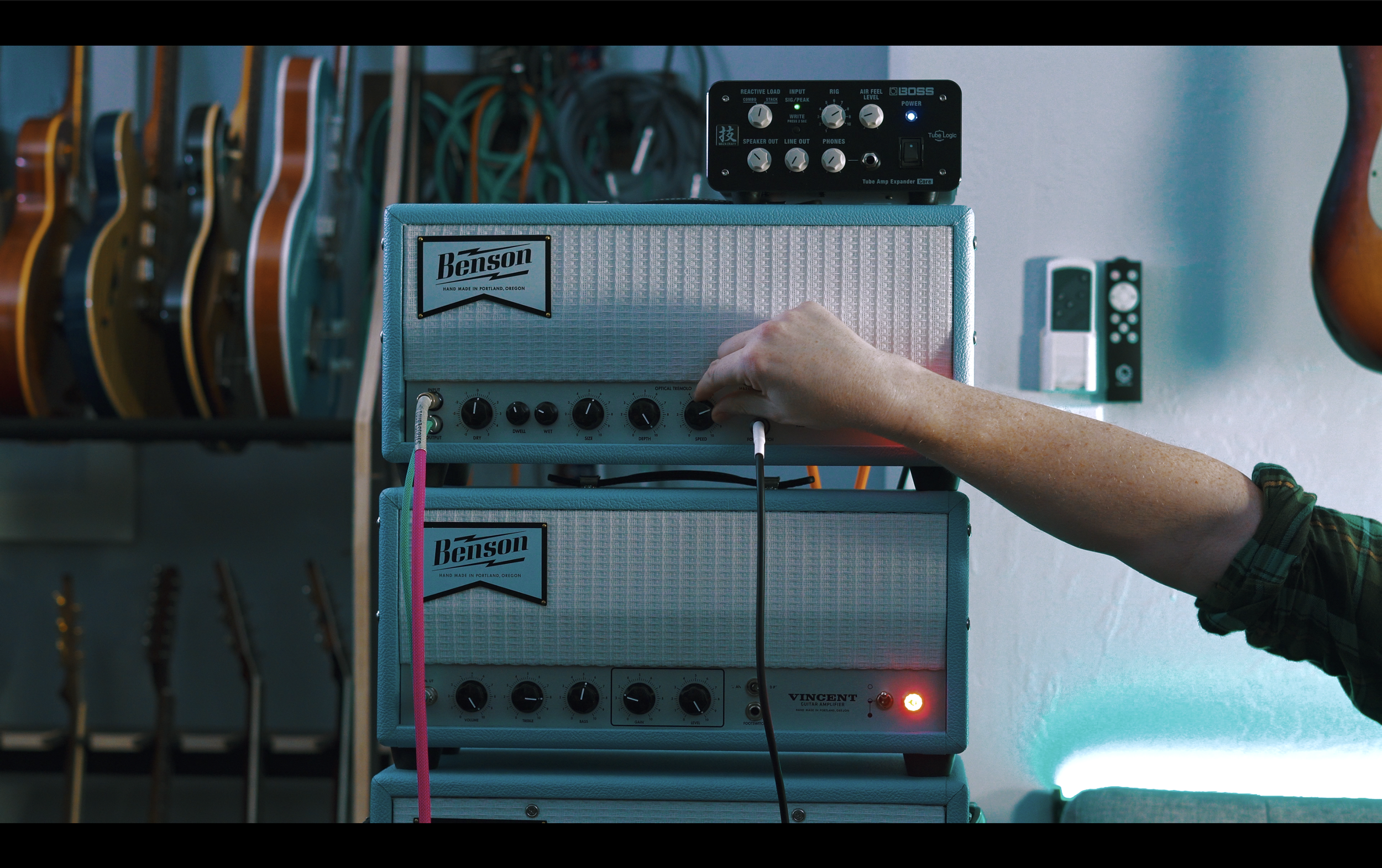
The Shock the Fox TGF — a one-of-a-kind bolt-on DeeCee model built by Tye Tyler from a single board of Pecky Cypress, with a dual carbon fiber and truss rod neck, Halon 1/2 Tele bridge aged in Greece, FoxLock neck pocket, and a Righteous Sound King Street P90 with matching Pecky Cypress insert. The King Street is an early-P90-inspired low-wind Alnico 2 design with broad midrange, growly lows, and top-end chime — an ideal voice for feeding a germanium circuit. Electronics are Emerson Premier Pro pots and cap, a custom Caroline Guitar Co treble bleed, and an Analysis Plus output jack. Into a Benson Redland 35 Head and 2x12" cabinet — 35 watts of 6L6-driven American tone with Chris Benson's uniquely interactive Redland EQ — with the Benson Tall Bird Plus all-tube spring reverb and harmonic optical tremolo running post-preamp in the loop of a Boss Waza Tube Amp Expander. It's a rig worthy of the fuzz in front of it.
This is what happens when NOS component obsession meets a builder who truly understands what the circuit wants to do.
Subscribe for more boutique tone explorations.
🎸 Shock the Fox TGF | Pecky Cypress | Righteous Sound King Street P90 | Emerson Premier Pro | Caroline Guitar Co Treble Bleed | Analysis Plus Jack | Halon 1/2 Tele Bridge (aged in Greece)
🎛️ Expresso FX Ge Fuzz Mini | NOS Newmarket CV7005 & Texas Instruments 2N1307
🔊 Benson Redland 35 Head & 2x12" Cab | Benson Tall Bird Plus
Time-O-Lite Fuzz | R2R Electric x Waterslide Guitars | Gibson ES-335 Tones (1967)
A darkroom timer from another era. Two NOS OC44 black glass germanium transistors. And one of the most singular fuzz enclosures ever to find its way onto a pedalboard. Welcome back to Edge of Breakup.
In this episode, the R2R Electric Time-O-Lite Fuzz takes center stage — piloted by my 1967 Gibson ES-335 loaded with Ron Ellis 60's Bette Humbuckers and Emerson Custom Treble Bleeds, into a vintage 1965 Fender Deluxe Reverb on the Normal channel.
The Time-O-Lite is the product of a long-time collaboration between founder of R2R Electric's Chris Vincent, and Waterslide Guitars — over two years in the making. The enclosures are genuine Time-O-Lite industrial darkroom timers, converted by hand into fuzz pedals with painstaking care for the original controls. The existing hardware has been repurposed rather than replaced — including the concentric potentiometer configuration, where the lower larger pointer controls Volume and the upper small red pointer controls Fuzz. Those pots are period-correct CTS units: a 1966 CTS 500k and a 1983 CTS 1k, working in concert. The rest of the component list is a collector's dream: NOS Allen-Bradley carbon comp resistors, NOS capacitors throughout, a 1979 ITT .01uf chicklet-style cap, and true bypass switching. Every pedal is unique and has aged in varying degrees — each one tells its own story before you've even played it.
This particular unit features a pair of hand-selected NOS OC44 black glass germanium transistors. R2R also builds the Time-O-Lite with OC42 and AC107 germanium transistors depending on the build — each transistor type imparts its own character, and every unit is individually matched and voiced to its specific pair. The OC44 is a low-noise, high-gain germanium device with a warm, musical compression character that sits beautifully in a Fuzz Face-style two-transistor circuit.
Tonally, the Time-O-Lite is a classic two-transistor germanium Fuzz Face-style circuit, shipped tuned to vintage Fuzz Face specs with an internal Blue trimpot for Q2 bias adjustment. The range — from gated and spitty at low bias to a large, open, blooming fuzz at full bias — is enormous, and the circuit is extraordinarily reactive to guitar volume and pick attack. Like all great germanium fuzzes, it rewards a light touch and punishes nothing. One important note: this is a true-to-vintage circuit that does not play well with buffers upstream — it must sit first in your signal chain with only true bypass pedals before it.
The 1967 Gibson ES-335 is one of the great guitar-and-fuzz pairings in existence — the semi-hollow body's natural woody resonance and acoustic bloom add a dimension to a germanium fuzz that a solid body simply cannot replicate. The Ron Ellis 60's Bette Humbuckers are specifically voiced for this application: based on the patent-era humbuckers used in early-to-late 60s ES Gibson guitars, they are fundamentally honest pickups that let the acoustic character of the instrument speak clearly. Hand-wound in Carlsbad, California and named after Ron's mother, the Bettes have beautiful musical timbre on every note — you can genuinely hear the wood of the guitar through them. The Emerson Custom Treble Bleeds keep high-frequency detail intact as you roll back the guitar's volume control, which in a fuzz-forward rig like this is not a luxury — it's essential.
Through the warm, bold voice of a 1965 Fender Deluxe Reverb, this combination of semi-hollow body, PAF-voiced humbuckers, and NOS germanium fuzz achieves something difficult to describe and impossible to fake.
Be sure to join @r2relectric email list so you know when his ultra limited hand-built NOS fuzzes, boosts and wahs hit Reverb to purchase! They DO NOT hang around long!
https://www.r2relectric.com/how-to-order
Subscribe for more boutique tone explorations.
🎸 1967 Gibson ES-335 | Ron Ellis 60's Bette Humbuckers | Emerson Custom Treble Bleeds
🎛️ R2R Electric Time-O-Lite Fuzz | NOS OC44 Black Glass Germanium Transistors
🔊 1965 Fender Deluxe Reverb
Other R2R Electric videos you might like:
https://www.edgeofbreakup.studio/latest-videos/the-best-nos-fuzz-face-r2r-electric-geface-deluxe
https://www.edgeofbreakup.studio/latest-videos/r2r-electric-uniform-fuzz
https://www.edgeofbreakup.studio/latest-videos/electric-machine-fuzz-r2r-electric-zonk-machine
https://www.edgeofbreakup.studio/latest-videos/1959-fender-tweed-deluxe-5e3-vintage-amp-showcase
https://www.edgeofbreakup.studio/latest-videos/r2r-electric-pkiii-fuzz
https://www.edgeofbreakup.studio/latest-videos/r2r-electric-mki-pro-fuzz
https://www.edgeofbreakup.studio/latest-videos/r2r-electric-pre-amp-vintage-wah
The Fuzz That Does Everything | Jam Pedals Eureka Fuzz
Two worlds of fuzz in one circuit. The singing, dynamic midrange of classic germanium. The gritty, full-bodied weight of a vintage Big Muff. Handmade in Athens, Greece. Welcome back to Edge of Breakup.
In this episode, the JAM Pedals Eureka! Fuzz takes center stage — running into my Kauer Guitars Electroliner loaded with Lollar Sixty-Four Stratocaster pickups, into my 1957 Fender Tweed Princeton 5F2-A with a 12" speaker.
JAM set out to solve a problem that's divided fuzz lovers for decades: the classic choice between germanium character and Muff-style weight.
Germanium fuzzes deliver singing, touch-sensitive midrange and enormous dynamic control off the guitar volume — but can lack the full-bodied low-end punch that cuts through a mix. Muff-style circuits deliver that massive, scooped, wall-of-sound character — but can lose the intimate responsiveness that makes a great fuzz feel alive. The Eureka! uses silicon transistors in a proprietary architecture to bring both worlds together in a single circuit, and the result is something genuinely hard to categorize. Some will say it sounds like a beefed-up germanium fuzz. Others will swear it sounds like a mid-range-enriched Muff-style pedal. Both are right.
The control layout is classic and simple — Level, Tone, and Gain — but the three-way toggle switch is where the Eureka! earns its name. It incrementally introduces more low-end as you move through its positions, making it extraordinarily versatile across different guitars and musical situations. In the lowest bass-boost position, sending a hot enough signal into the circuit unlocks a gated-fuzz response — a completely different, sputtering, staccato character that sits at the far end of the tonal range. The overall palette covers everything from nasally 60s Fuzzrite character to girthy 70s Big Muff weight, with searing mid-rich lead lines, super-heavy riffs, and flat-out noise annihilation all available on demand.
Paired with the pre-CBS single-coil clarity of the Lollar Sixty-Four set and the warm, compressed voice of the 5-watt tweed Princeton circuit, the Eureka! reveals exactly why the bass-boost toggle is such a smart inclusion — single coils into a small-watt amp benefit enormously from that extra low-end muscle, and the Eureka! delivers it without sacrificing any of the midrange character that makes the circuit special.
Handmade and hand-painted in Athens, Greece, using the highest quality materials and rare NOS components. This is boutique fuzz done right.
Subscribe for more boutique tone explorations.
🎸 Kauer Guitars Electroliner | Lollar Sixty-Four Stratocaster Set
🎛️ JAM Pedals Eureka! Fuzz
🔊 1957 Fender Tweed Princeton 5F2-A | 12" Speaker
Your Klon Search is Over | Mythos Pedals Joey Landreth Mjolnir Overdrive
Mythos Pedals Joey Landreth Mjolnir Overdrive
A Nashville friendship, a Klon-style circuit, NOS germanium diodes, and a sparkle orange finish that makes every other overdrive on your board jealous. Welcome back to Edge of Breakup.
In this episode, the Mythos Pedals Joey Landreth Mjolnir Overdrive takes center stage — running into my Kauer Guitars Electroliner loaded with Lollar Sixty-Four Stratocaster pickups, into my 1957 Fender Tweed Princeton 5F2-A with a 12" speaker.
The Mjolnir is Mythos Pedals builder Zach Broyles' deeply considered take on the modern classic Klon Centaur circuit — tweaking the clipping for consistency and a slight boost in clarity, while preserving everything that made the original a landmark piece of overdrive design. Like the Klon, it runs internally at 18V despite accepting standard 9V DC, and uses buffered bypass so your signal receives a boost in clarity even when the pedal is switched off. At low gain settings it functions as a supremely transparent, enormously loud clean boost — at higher gain settings it delivers a rich, dynamic overdrive voice that accents your rig without ever taking anything away from it.
The Joey Landreth edition is something more personal than a standard Mjolnir. The story begins in 2014, when Zach met Joey Landreth — killer guitarist, fantastic vocalist, master of tone — at The Basement in Nashville, Tennessee. They immediately started talking tone and became fast friends. The very first Mjolnir Zach built for Joey featured vintage NOS germanium diodes, and Joey loved it enough that it became his reference point for what a K-Style overdrive should feel like. The Joey Landreth edition is a replica of that pedal — inspired by and faithful to the original unit Joey has been running ever since. Handmatched NOS germanium clipping diodes give it a beautiful compression when the gain is pushed, and a clarity and personality that is measurably more mellow, softer clipping, and smoother than the standard Mjolnir variants. Limited to just 60 pedals worldwide, hand assembled by Zach and Morgan Broyles in Nashville, Tennessee, in a translucent sparkle orange finish with cream Bakelite-style knobs and an orange LED.
Into a 5-watt, single 6V6, Class A tweed Princeton circuit and the pre-CBS Alnico clarity of Lollar Sixty-Four single coils, the Joey Landreth Mjolnir finds a natural home. Its transparency and touch sensitivity reward a light touch and punish nothing — and its buffered bypass means it's quietly improving your signal even when it's off.
This is a pedal built around a friendship and a shared obsession with tone. It sounds exactly like that.
Subscribe for more boutique tone explorations.
🎸 Kauer Guitars Electroliner | Lollar Sixty-Four Stratocaster Set
🎛️ Mythos Pedals Joey Landreth Mjolnir Overdrive | NOS Germanium Diodes | Limited Edition
🔊 1957 Fender Tweed Princeton 5F2-A | 12" Speaker